
High temperature melting point test case
2026-04-25
Here is the English translation of...
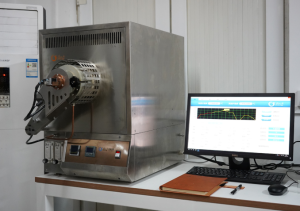
Here is the English translation of the provided text about high-temperature melting point testing for metallurgical slags.
It is another important physical property of metallurgical slags. Given the complexity of the slag melting process, the melting point usually refers to multiple temperatures such as the softening temperature, hemispherical temperature, and flow temperature. With the development of science and technology, there is a need to systematically understand the detailed information of the slag melting process, which imposes higher demands on melting point testers: a wider temperature range (1000°C–1700°C), controllable atmosphere (for regulation of slag mineral phases and structures), and high‑resolution image information that can be recorded online at any time. The importance of testing the fusibility of metallurgical industrial slags thus requires the ability to test the ash fusibility characteristics of fuels.
(I) Functional requirements
Test methods: Comply with standards such as ASTM D1857‑87, DIN51730, BS1016, ISO540, etc.
Measurable parameters: Initial deformation temperature, softening temperature, hemispherical temperature, flow temperature.
Application areas: Melting point testing of various metallurgical slags, development of fluxes, preparation of inorganic materials, etc.
High‑precision temperature control and multiple heating regimes.
Automatic operation using image analysis technology to determine slag melting points.
(II) Advanced requirements
The maximum temperature of the system heating element can reach 1800°C.
The maximum vacuum level of the system can reach 10⁻⁴ mbar.
Capable of monitoring, computer‑based calculation, data storage, and curve plotting.
Can test up to 8 samples simultaneously, automatically capturing sample shapes.
(III) CCD video system parameters
High‑definition camera capable of recording high‑speed, clear test images.
Equipped with a quartz transparent observation window; can handle up to 12 samples per operation.
The computer can store images at set time and temperature intervals, and directly record the entire process from the CCD video system.
Images include date, time, temperature, and can record temperature points (IT, ST, HT, FT) as well as sample shape.